Original variant: three-stage financing for a community workshop
A 50,000 workshop loan charges 8% effective annually. The first five payments are interest only. Each of the next five equals 120% of that year's interest. The remaining balance is then amortized by five equal year-end payments. Find the final-stage payment.
A 10,500.00
B 11,000.00
C 11,552.55
D 12,000.00
E 12,500.00
Show the answer and worked solution
Answer and calculation
The middle stage leaves 46,125.97, whose five-payment amortization is 11,552.55, choice C.
Setup
Setup
Interest-only service preserves the original balance for five years.
B5=50000
Model
Model
A payment equal to 120% of interest applies 20% of that interest amount to principal, reducing balance by 1.6% each middle-stage year.
B10=50000(1−0.20(0.08))5=46125.97
Compute
Compute
After five such reductions, the residual is 46,125.97; dividing by the five-year annuity factor gives 11,552.55.
P=B10/a5∣0.08=11552.55
Answer
Answer
The final-stage annual payment is 11,552.55, choice C.
P=11552.55(C)
Calculator reproduction
BA II Plus keystrokes
2nd CLR TVM; 2nd I/Y; 1 ENTER; ↓; 1 ENTER; 2nd CPT; 2nd PMT; if BGN is displayed, 2nd ENTER; 2nd CPT; 5 N; 8 I/Y; 46125.97 PV; 0 FV; CPT PMTPMT = -11552.55END mode; I/Y is the annual effective rate and the final-stage repayments are negative.
Technique orientation
What loan amortization and balances questions are testing
A loan balance at time k is the value at that same time of what remains to be paid. The prospective method values future payments; the retrospective method accumulates the original advance and subtracts accumulated past payments. They are two views of one equation of value and provide a strong built-in cross-check.
Exam FM asks for balances immediately before or after a payment, principal and interest portions, revised payments, and refinancing values. Draw the time-k boundary explicitly. Then count remaining payments from that boundary and use the contractual loan rate unless a separate fund or refinancing rate is stated.
Recognition audit
Signals that this is the right method
A principal is repaid through a stated sequence of payments at a contractual effective rate.
The question asks for an outstanding balance after a specified number of payments.
A payment must be split into interest on the prior balance and principal reduction.
Terms change through refinancing, extra payments, a balloon payment, or a new repayment schedule.
Before calculation
A disciplined first pass
Name the requested quantity, mark its units or time point, and identify the assumption that permits the formula. Only then insert the numerical inputs. This separates model errors from arithmetic errors and makes the answer-choice comparison auditable.
Formula core
Loan Amortization and Balances formulas to know
These identities are starting points, not substitutes for checking support, timing, rate periods, or independence assumptions.
Original loan equation
L=Ran∣i
R is the level end-of-period payment when the loan is an annuity-immediate.
Balance after the kth payment
Bk=Ran−k∣i=L(1+i)k−Rsk∣i
The prospective and retrospective expressions must agree at the same point in time.
Interest and principal portions
Ik+1=iBk,Pk+1=R−Ik+1,Bk+1=Bk−Pk+1
Interest for the next payment period is calculated from the balance immediately after the preceding payment.
Three failure modes to catch
Using n rather than n − k as the remaining term in a prospective balance.
Computing a payment’s interest portion from the balance after that payment.
Valuing a refinancing or sinking-fund cash flow at the original loan rate when a different rate is specified.
Compare the time point
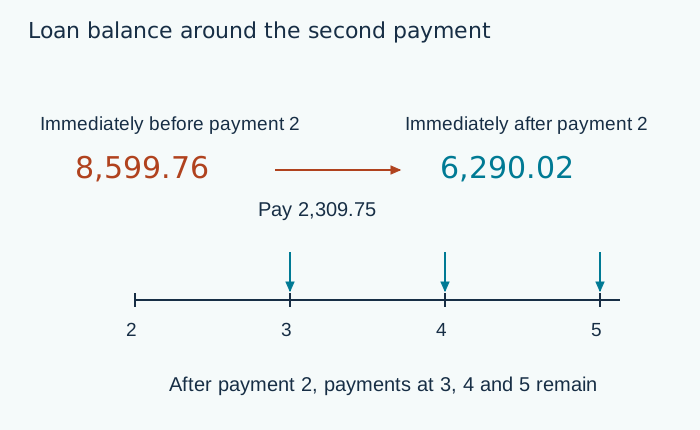
A loan balance immediately before and after a payment
The linked formula example uses a 10,000 loan, five annual payments and 5% effective annual interest. The same instant at payment two has two balances, separated by the payment itself.
Unrounded payment: 2309.747981. Before payment two: 8599.764620. After payment two: 6290.016638. Display rounding does not change the internal calculation.
Immediately before payment two, include the payment due now plus the three future payments. Immediately after payment two, only the three future payments remain. Accumulating the original loan and subtracting the first two payments independently checks the after-payment balance.
Original ActuaryProof diagrams and calculations, October 1, 2026. Personal study and unchanged redistribution with attribution are permitted. This independent study aid is not an official SOA handout or material permitted in the exam.
Verified practice ledger
Exam FM loan amortization and balances problems and solutions
The list is grouped by current official syllabus area. Every link opens a step-labeled solution, verification artifact, distractor analysis, and one fully worked original variant.
Keep every worked reference in one searchable manual
The complete Exam FM manual includes all active sample-reference solutions, their wrong-choice analysis, and one independently written worked variant per reference. The free formula sheet is the compact companion for recall between practice sessions.