Free Exam FM financial mathematics reference · 9-page PDF

Free SOA Exam FM formula sheet PDF

A syllabus-organized financial mathematics reference with assumptions, timing or boundary checks, and practical guidance on choosing the right formula.

Purpose

A formula reference built for recognition, not decoration

This Exam FM formula sheet is built around one governing idea: every cash flow must be valued at one declared comparison date using a consistent interest-rate convention. The nine-page PDF follows the August 2026 Financial Mathematics syllabus and covers interest measurement, annuities, varying payments, loans, bonds, yield calculations, duration, convexity, and immunization. It also includes a BA II Plus field guide because correct formulas can still produce wrong answers when payment frequency, calculator state, or cash-flow signs are inconsistent.

The sheet is deliberately more explicit than a one-page equation list. Symbols such as i, d, v, i^(m), and delta are not interchangeable, and the difference between an annuity-immediate and an annuity-due is a full payment period. Each major identity is placed near its timing assumptions and a comparison-date reminder. Loan and bond sections show both the compact formula and the underlying cash-flow interpretation so that unfamiliar wording can be rebuilt instead of forced into a memorized template.

Use this reference after drawing the timeline, not before. Mark time zero, payment dates, the focal date, the effective period attached to the rate, and the sign of each cash flow. Then select the formula or calculator worksheet that exactly matches that timeline. This workflow is slower for a few practice sessions and faster on the real exam because it prevents the silent one-period and frequency errors that otherwise survive to the answer choices.

Inside the PDF

What the Exam FM formula sheet covers

The nine pages move from rate language to cash-flow valuation and then to instruments and risk measures.

Interest and discount conversion

Effective rates, nominal rates convertible m-thly, force of interest, discount rates, accumulation functions, and present-value factors are tied to their measurement period.

Level and varying annuities

Immediate, due, deferred, perpetuity, arithmetic-increasing, and geometric-payment formulas are shown with timelines and payment-count checks.

Loans and amortization

Prospective and retrospective balances, principal and interest portions, sinking funds, and refinancing equations are organized around the valuation date.

Bonds and yield

Coupon valuation, book value, premium and discount amortization, callable prices, yield equations, and reinvestment assumptions are connected to explicit cash-flow vectors.

Portfolios and asset-liability management

Dollar-weighted and time-weighted returns, spot and forward rates, Macaulay and modified duration, convexity, and immunization conditions appear with the quantities they approximate or match.

BA II Plus field guide

TVM and cash-flow worksheet state, P/Y and C/Y, END/BGN mode, sign convention, IRR, precision, and clearing sequences are summarized as a pre-computation audit.

Formula examples

Major Exam FM identities and when to use them

These examples illustrate the timeline-first notation used throughout the PDF. The sheet supplies the surrounding rate and calculator checks.

01

Move a value across n effective periods

A(t+n)=A(t)(1+i)n,v=(1+i)1A(t+n)=A(t)(1+i)^n,\qquad v=(1+i)^{-1}

Use accumulation to move forward and v^n to move backward when i is effective for one payment period. Convert a quoted nominal or annual rate before using n.

02

Value level end-of-period payments

ani=1vni,a¨ni=(1+i)ania_{\overline{n}\mid i}=\frac{1-v^n}{i},\qquad \ddot a_{\overline{n}\mid i}=(1+i)a_{\overline{n}\mid i}

Use the immediate factor when the first payment is one period after the valuation date. Use the due factor when the first payment occurs at the valuation date.

03

Balance a loan prospectively

Bk=RankiB_k=R\,a_{\overline{n-k}\mid i}

Immediately after payment k, value the remaining n-k payments at that date. If the balance is requested immediately before a payment, include that payment in the remaining stream.

04

Price a coupon bond at a yield rate

P=Franj+CvjnP=Fr\,a_{\overline{n}\mid j}+Cv_j^n

Use coupon amount Fr, redemption amount C, and yield j on the coupon period. A nominal annual yield must be converted to the coupon-period yield before n is counted.

05

Measure first-order price sensitivity

DMac=ttCtvtP,Dmod=DMac1+iD_{\mathrm{Mac}}=\frac{\sum_t t\,C_t v^t}{P},\qquad D_{\mathrm{mod}}=\frac{D_{\mathrm{Mac}}}{1+i}

Use Macaulay duration as the present-value-weighted time and modified duration for the local percentage price response to an effective yield change.

Decision guide

When to use each part of the sheet

The right Exam FM formula is determined by timing, rate period, and the unknown—not by a keyword alone.

  1. When rates use different labels

    Convert every rate to the effective period used by the cash flows. Never divide an effective annual rate by the number of payments; that shortcut applies only to a nominal rate explicitly convertible at that frequency.

  2. When payments start later or occur at the beginning

    Value the standard annuity at the date immediately before its first payment, then discount or accumulate to the requested date. A timeline makes the deferral exponent visible.

  3. When a loan balance is requested

    Choose prospective valuation of remaining payments or retrospective accumulation of the original loan less past payments. Using both routes in practice is an excellent check on payment count and focal date.

  4. When a yield must be solved

    Write the full price equation before using IRR or a root solver. Confirm that cash-flow signs change, that timing indices are correct, and that the result is reported in the requested annual or period convention.

  5. When duration or immunization appears

    First match present values at the same yield curve assumption, then match the required duration measure. Convexity is not a substitute for satisfying the first-order conditions.

Error prevention

Typical Exam FM formula mistakes

Exam FM distractors often reproduce a clean calculation performed at the wrong date or with the wrong period rate.

  • Valuing cash flows at several dates at once

    An equation of value must compare every term at one focal date. Label the date above the equation and move every payment there before solving.

  • Confusing nominal and effective rates

    A nominal rate convertible m-thly is divided by m to obtain the periodic rate; an effective annual rate must instead be converted by taking an m-th root of its annual accumulation factor.

  • Dropping or adding one annuity payment

    Count payment dates explicitly. The difference between a balance just before and just after a payment is not cosmetic—it changes both the number of payments and sometimes the focal date.

  • Leaving stale BA II Plus state

    P/Y, C/Y, BGN mode, stored TVM values, and cash-flow worksheet entries persist. Clear the worksheet and confirm END/BGN and frequency settings before interpreting a calculator result.

  • Using inconsistent cash-flow signs

    At least one cash flow must have the opposite sign for TVM or IRR calculations. Pick a viewpoint—investor or borrower—and keep receipts and payments consistent throughout.

  • Rounding the periodic rate too early

    Store full calculator precision through the valuation and round only the requested output. Small rate truncations compound over many periods and can move the result to a neighboring answer choice.

PDF preview

See the reference before downloading

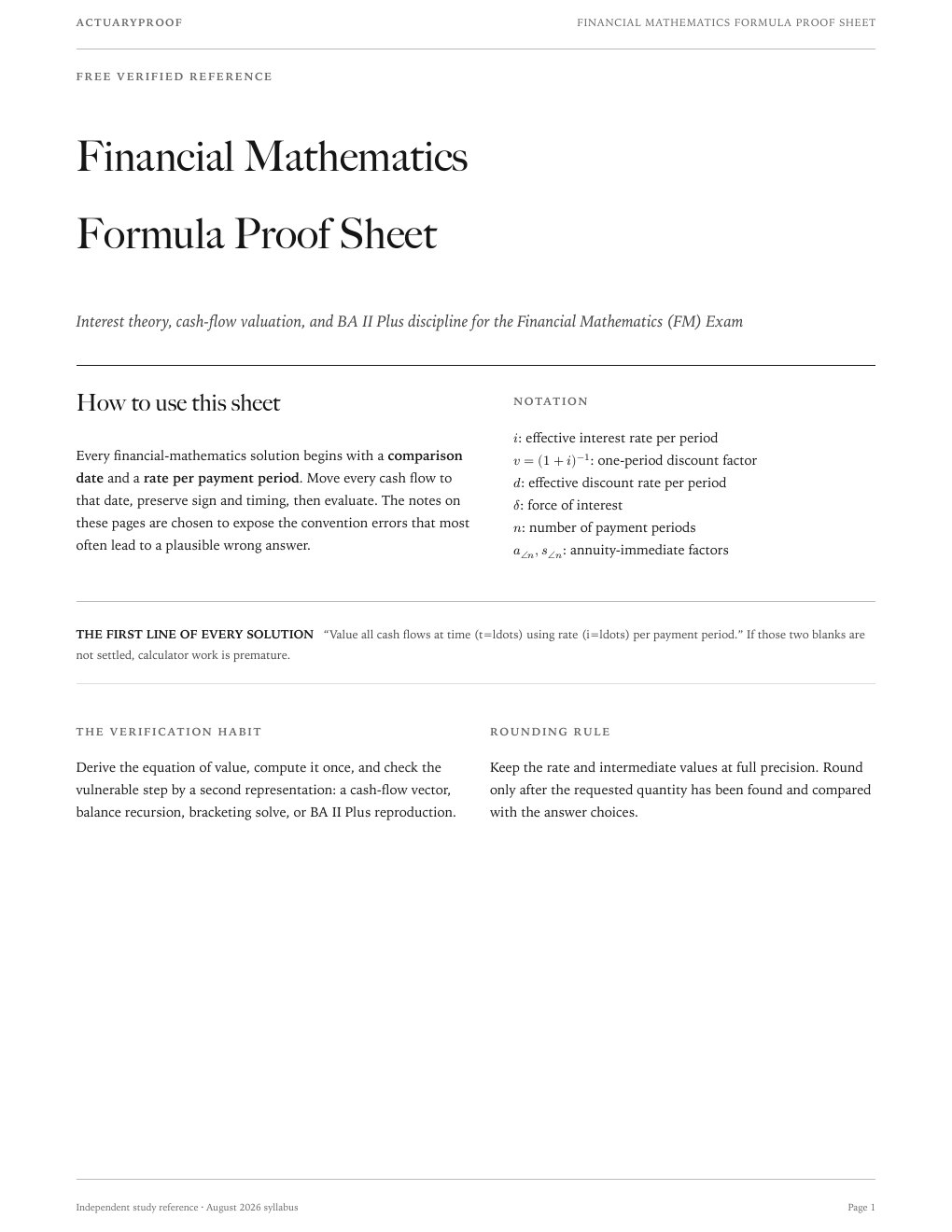
Representative full-page images show the typography, notation, and amount of guidance included in the free edition.

Financial Mathematics formula sheet preview page 1
Cover, interest measures, and rate conversion
Financial Mathematics formula sheet preview page 2
Annuity factors and payment-timing diagrams
Financial Mathematics formula sheet preview page 3
Loans, bonds, duration, and BA II Plus checks

Study method

A timeline-first Exam FM practice routine

For each practice problem, spend the first twenty seconds drawing a horizontal timeline and writing the periodic effective rate above it. Mark the comparison date with a vertical stroke. Only then open the formula sheet. Point to the payment pattern that matches the drawing and state why it is immediate, due, deferred, varying, or irregular. This discipline makes formula selection reproducible instead of dependent on a familiar phrase.

After the algebraic solution, reproduce applicable calculations on the BA II Plus using a cleared worksheet and explicit sign convention. Do not treat calculator agreement as a second mathematical method; use it to expose data-entry, frequency, and rounding errors. Finally, compare your setup with the verified ActuaryProof solution and record whether any miss came from rate conversion, payment timing, focal date, cash-flow signs, or rounding. The category tells you which formula-sheet checkpoint to rehearse next.

Start in the free Exam FM solution library, or browse its syllabus topics to keep the retrieval drill focused.

Use the Exam FM BA II Plus guide for END/BGN, P/Y and C/Y, sign conventions, TVM, cash flows, NPV, IRR, amortization, and checked calculator examples.

Get the $19 formula cards and verified calculator workflows →

Complete worked reference

Move from the formula to every official sample reference

The Financial Mathematics Proof Manual contains all 461 active official sample-reference solutions, 461 fully worked original variants, concrete wrong-choice analysis, and BA II Plus workflows wherever applicable across 2,210 pages.