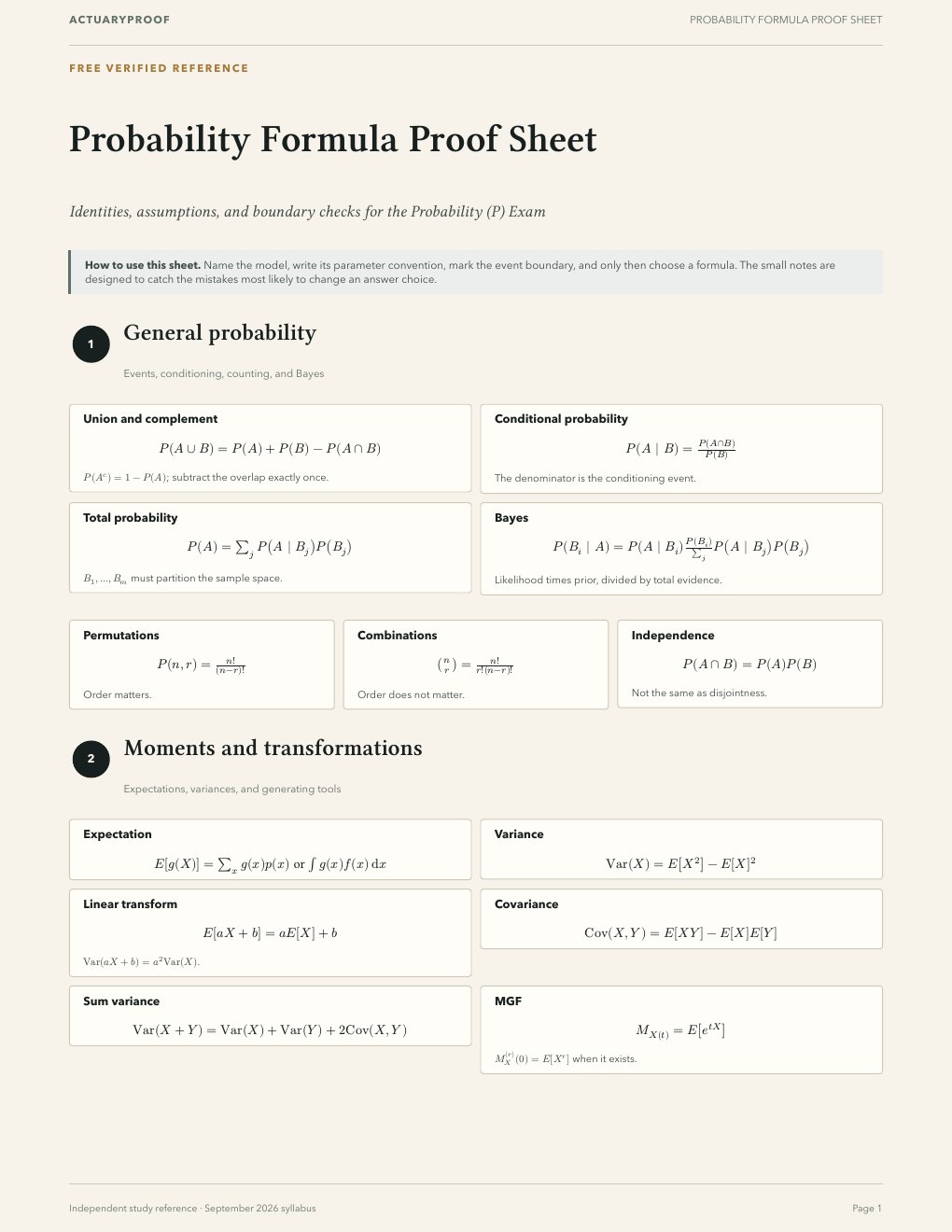
Free Exam P probability reference · 4-page PDF

Free SOA Exam P formula sheet PDF

A syllabus-organized probability reference with assumptions, timing or boundary checks, and practical guidance on choosing the right formula.

Purpose

A formula reference built for recognition, not decoration

This Exam P formula sheet is a compact probability reference for candidates who already know the ideas and need to retrieve the right identity quickly. It follows the September 2026 Probability syllabus and groups formulas by the decision a problem requires: combine events, condition on information, identify a distribution, calculate a moment, transform a variable, or work with a joint model. The PDF is not a substitute for learning probability from first principles. Its job is to shorten the distance between recognizing a model and writing the correct setup.

A useful formula sheet must do more than list symbols. The same-looking expression can be wrong when a support boundary is open instead of closed, when a geometric variable counts failures rather than trials, or when a rate parameter is mistaken for a mean. For that reason, this edition puts assumptions and parameter conventions beside the formulas. It also includes a pre-answer audit for checking support, complements, conditioning denominators, units, and whether the requested quantity is a probability, density, percentile, expectation, or variance.

Use the sheet beside the official sample-question PDF and the ActuaryProof worked-solution library. Attempt the question first, mark the model and target quantity, then consult only the relevant section. After solving, compare the setup—not merely the answer letter—with the verified solution page. That sequence turns the PDF into a recall tool instead of a shortcut that hides gaps in understanding.

Inside the PDF

What the Exam P formula sheet covers

The four pages are organized for exam-speed retrieval while retaining the assumptions that determine whether a formula is valid.

Events, counting, and conditional probability

Complements, unions, inclusion–exclusion, independence, Bayes’ theorem, total probability, permutations, and combinations appear together so that the event structure is settled before numerical work begins.

Random variables and moments

Expected value, variance, covariance, conditional moments, transforms, quantiles, and loss-variable notation are grouped by the quantity being requested rather than by alphabetical symbol.

Named distributions

Bernoulli, binomial, geometric, negative binomial, Poisson, uniform, exponential, gamma, beta, and normal entries state their support and the parameter interpretation used on the sheet.

Joint models and approximations

Marginalization, conditional densities, independence tests, sums, order statistics, the law of total variance, and common normal or Poisson approximations are paired with boundary and continuity-correction reminders.

Formula examples

Major Exam P identities and when to use them

These examples show how the page records both the identity and the condition that makes it useful. The downloadable PDF contains the larger indexed set.

01

Condition on observed information

P(AB)=P(AB)P(B),P(B)>0P(A\mid B)=\frac{P(A\cap B)}{P(B)},\qquad P(B)>0

Use this when the sample space has been restricted by evidence B. Write the intersection in the numerator before substituting; reversing A and B is one of the most common conditional-probability errors.

02

Decompose an unconditional probability

P(A)=iP(ABi)P(Bi)P(A)=\sum_i P(A\mid B_i)P(B_i)

Use total probability when the cases B_i form a disjoint, exhaustive partition. It is especially effective for mixtures, classification questions, and latent risk groups.

03

Separate within-group and between-group variation

Var(X)=E[Var(XY)]+Var(E[XY])\operatorname{Var}(X)=E[\operatorname{Var}(X\mid Y)]+\operatorname{Var}(E[X\mid Y])

Use the law of total variance when conditioning makes the model simpler. Keep the two terms conceptually separate: average conditional uncertainty plus variation among conditional means.

04

Transform a continuous variable

fY(y)=fX ⁣(g1(y))ddyg1(y)f_Y(y)=f_X\!\left(g^{-1}(y)\right)\left|\frac{d}{dy}g^{-1}(y)\right|

Use this one-to-one form only after deriving the transformed support. For a many-to-one transformation, sum the contribution from every inverse branch.

05

Standardize a normal variable

Z=Xμσ,XN(μ,σ2)Z=\frac{X-\mu}{\sigma},\qquad X\sim N(\mu,\sigma^2)

Use standardization for normal probabilities and percentiles. The denominator is the standard deviation, not the variance, and an inequality must remain oriented consistently through the transformation.

Decision guide

When to use each part of the sheet

The fastest way to use a probability reference is to identify the mathematical object before searching for a named formula.

  1. When the wording describes overlapping groups

    Sketch the events and decide whether the target is a union, intersection, complement, or conditional event. Reach for inclusion–exclusion only after the requested region is explicit.

  2. When a waiting-time or count model appears

    Write the support and parameter meaning first. A Poisson rate over an interval must be scaled to that interval; an exponential survival probability uses the same rate convention but a different random variable.

  3. When the question asks for a percentile

    Start from the CDF equation F(x)=p and solve for x. Do not confuse a density height with accumulated probability, and verify that the resulting quantile lies in the support.

  4. When several random quantities are combined

    Check independence before dropping covariance terms. For conditional or mixture models, conditioning may be the cleanest route even when a direct integral is possible.

Error prevention

Typical Exam P formula mistakes

Most lost Exam P points come from choosing the right family of formulas with one wrong convention or boundary.

  • Using independence without proving or being given it

    Zero covariance does not generally imply independence. Factor a joint density or use an explicit assumption before multiplying marginal probabilities or deleting covariance terms.

  • Mixing density and probability

    For a continuous variable, f(x) is not P(X=x). Probabilities are integrals over intervals, and the endpoints usually matter only when a distribution has atoms.

  • Forgetting transformed support

    A correct Jacobian with an incorrect range still produces a wrong density. Transform the endpoints and account for every inverse branch before integrating.

  • Misreading distribution parameters

    Gamma and exponential notation may use rate or scale; geometric notation may count trials or failures. Translate the stated convention into mean, variance, and support before applying a memorized expression.

  • Applying an approximation without its correction

    A normal approximation to a discrete count needs the appropriate continuity boundary. Check whether the requested event includes the endpoint before shifting by one half.

PDF preview

See the reference before downloading

Representative full-page images show the typography, notation, and amount of guidance included in the free edition.

Probability formula sheet preview page 1
Cover, probability notation, and event identities
Probability formula sheet preview page 2
Random variables, moments, and named distributions
Probability formula sheet preview page 3
Joint models, transformations, and approximations

Study method

A ten-minute daily Exam P retrieval drill

Choose one syllabus section and cover the formulas with a blank sheet. For each entry, write the random variable, support, assumptions, and one diagnostic phrase that tells you when to use it. Then reveal the PDF and correct the convention rather than merely checking whether the symbols look similar. This takes longer than passive reading for the first few sessions but creates much faster recognition under time pressure.

Finish with two official sample references from the matching topic hub. Work from the official wording, record your answer, and inspect the independently authored ActuaryProof solution only afterward. If the answer is wrong, label the cause as event setup, distribution choice, parameter convention, support or boundary, algebra, or arithmetic. Revisit the corresponding line on the sheet the next day. The formula becomes memorable because it is attached to a diagnosed mistake.

Start in the free Exam P solution library, or browse its syllabus topics to keep the retrieval drill focused.

Get the $19 formula and distribution cards →

Complete worked reference

Need the formula inside a complete worked solution?

The Probability Proof Manual contains all 718 active official sample-reference solutions, 718 fully worked original variants, concrete wrong-choice analysis, and a searchable syllabus structure across 3,108 pages.