
Already studied the topics? Put your reasoning through a fresh paper.
Exam P Practice Exam PDF with Full Solutions
Work through 30 original Exam P practice questions, then compare your work with explanations for every wrong option. Use the printable PDF for one three-hour sitting and a focused review of errors and guesses.
A searchable English PDF for personal study and printing. Original questions; no official wording is reproduced.
- New practice problems
- 30
- Pages
- 77
- Time limit
- 180 min
- Price (USD)
- $39 + tax
Try question 1 and read its solution · See printed pages
One-time purchase · no subscription. Stripe shows applicable tax and the final total before you pay.
Sold by Boson · Delivery & refund conditions · Ask a question
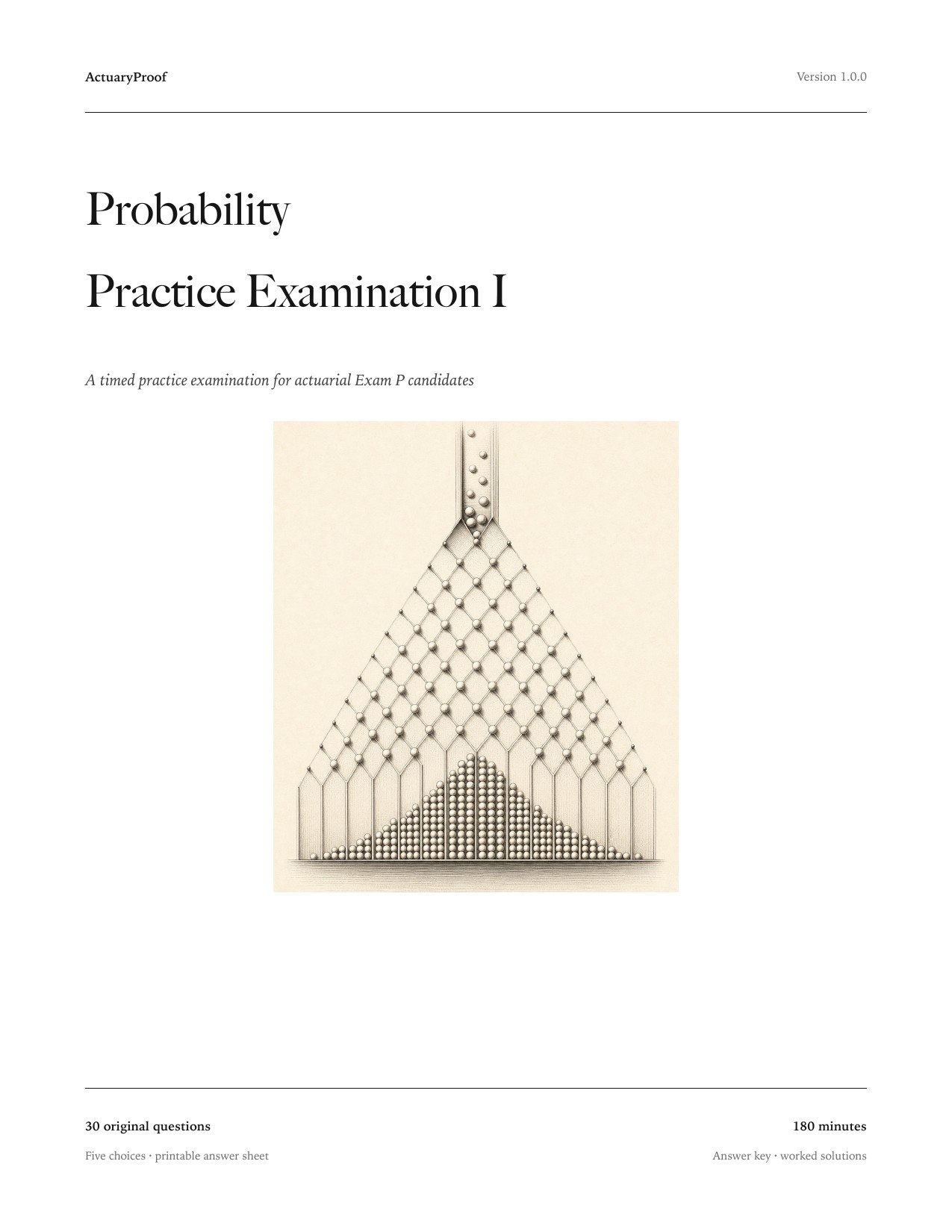
Using this edition for November 2026
The delivered PDF is version 1.0.1, the November 2026 practice edition revised on October 12. Its 30-question, three-hour format and topic proportions match the November 2026 official syllabus. The official exam window is November 4–15, 2026.
Edition update: questions 13 and 14 now cover a discrete joint distribution and a sum of independent discrete claim counts, replacing two continuous-joint-distribution problems from version 1.0.0. Full independent syllabus coverage and exam-difficulty calibration have not been verified; a practice score does not predict an exam result.
Actual product pages
Free preview: cover, questions and worked solution
Read PDF pages 1, 7, 41 below, or open each full-size image. These are pages from version 1.0.1, the 77-page PDF delivered after checkout.
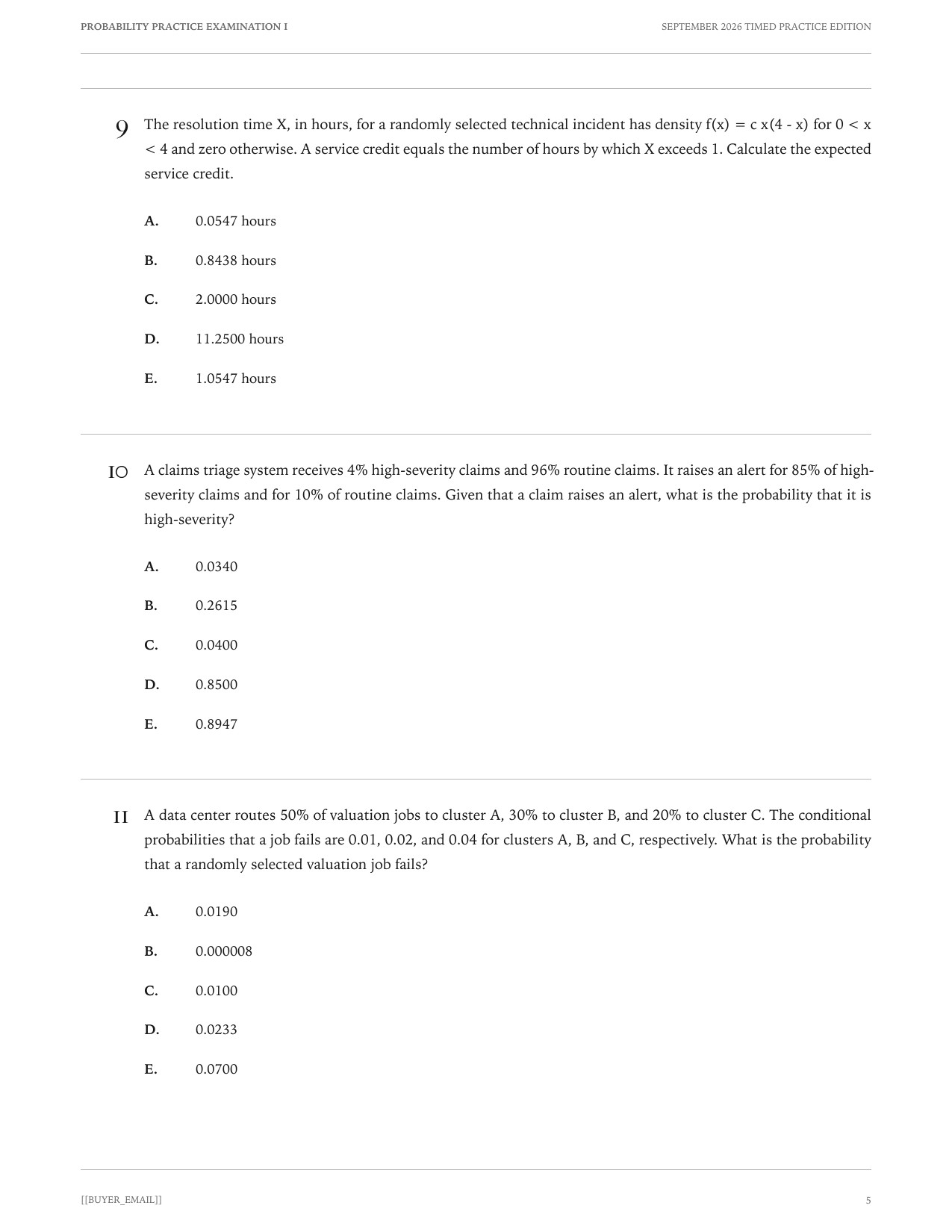
Question 13: worked conditional probability and wrong-choice analysis
Question 13: 1/3 stops at the joint probability before dividing by P(Y=2). A 2/3 result can come from treating the outcomes as equally likely, despite their weights 2, 3 and 4. Conditioning gives 5/9. Compare these possible errors with your own steps.
Open full-size page →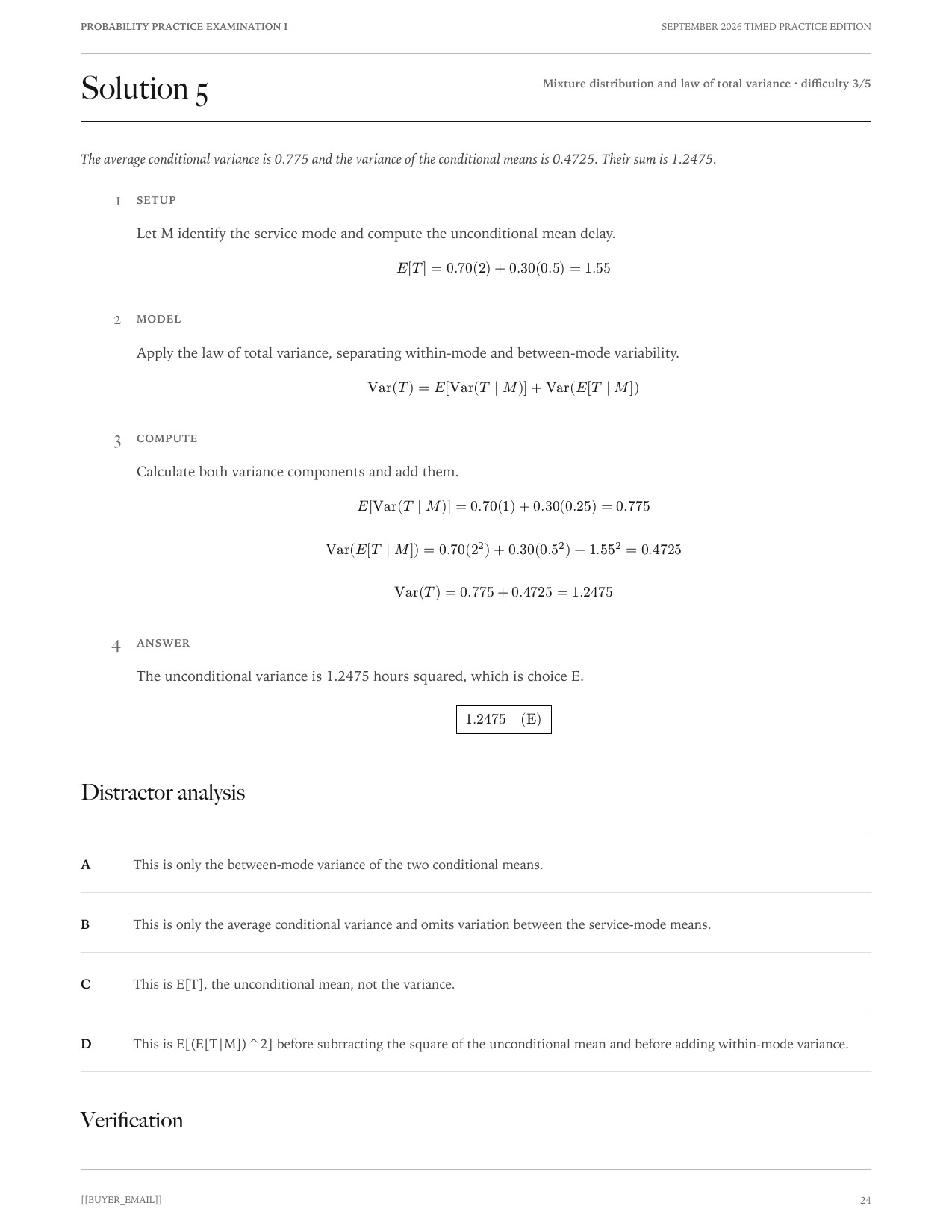
Check the method before checkout.
Question 1 from the delivered PDF
Free sample: question 1 with full solution
A consulting practice must schedule five distinct internal reviews—mortality, morbidity, lapse, expense, and capital—in five consecutive meeting slots. The mortality review must precede the morbidity review, and the lapse and expense reviews may not occupy adjacent slots. How many schedules satisfy both rules?
- 24
- 30
- 36
- 48
- 60
Count schedules that satisfy the precedence rule, then remove those in which lapse and expense are adjacent.
Setup
Exactly half of the 5! unrestricted schedules place mortality before morbidity, so 60 schedules satisfy the precedence rule.
Model
For the prohibited schedules, treat lapse and expense as one block. The block has two internal orders, and symmetry again places mortality before morbidity in half of those arrangements.
Compute
Subtract the 24 prohibited adjacent schedules from the 60 precedence-valid schedules.
Answer
There are 36 schedules satisfying both rules, so the correct choice is C.
Why the other choices are wrong
- A
- Counts the 24 schedules in which lapse and expense are adjacent, which are precisely the schedules that must be excluded.
- B
- Takes half of the 60 precedence-valid schedules without actually counting the nonadjacent lapse-expense placements.
- D
- Subtracts only 12 adjacent schedules, omitting one of the two internal orders of the lapse-expense block.
- E
- Enforces mortality before morbidity but ignores the restriction on adjacent lapse and expense reviews.
Two calculation paths for this answer
| Primary value | 36 |
|---|---|
| Primary method | Complement count: 5!/2 precedence-valid schedules minus (4! times 2)/2 adjacent schedules. |
| Independent value | 36 |
| Independent method | There are 6 nonadjacent unordered slot pairs for lapse and expense, 2 orders within each pair, and 3!/2 arrangements of the remaining reviews with mortality before morbidity: 6 times 2 times 3 = 36. |
| Answer | C · agreement passed |
Contents
Inside the 77-page edition
Candidates who have studied probability and want extra timed practice with worked review.
Table of contents
- Candidate instructions and 180-minute timing plan
- 30 original five-choice questions
- Printable answer sheet
- Answer key
- 30 complete Setup–Model–Compute–Answer solutions
- Analysis of all 120 incorrect choices
- Independent verification record for every answer
How to use the timed paper
- Print the questions and answer sheet; keep the key and solutions out of sight.
- Set a 180-minute timer. Record one choice per question; mark difficult items and return to them.
- Check the key, then use the worked steps and wrong-choice analysis to review both errors and guesses.
How to review an Exam P practice exam: errors, guesses and timing →
What is included
30 independently authored questions: 8 General Probability, 14 Univariate Random Variables, and 8 Multivariate Random Variables. No official problem wording is included.
The split is 26.7% / 46.7% / 26.7%, within November’s published ranges of 23–30% / 44–50% / 23–30%. See the edition update above.
Best for candidates who have studied the probability topics and want another timed paper. Difficulty labels in the PDF are the publisher’s: 1 question at 1/5, 11 at 2/5, 13 at 3/5 and 5 at 4/5. They are not calibrated against SOA exam difficulty.
SOA offers free official questions and an online sample exam. This purchase adds 30 original questions, analysis of all 120 wrong choices, and a printable PDF for offline practice.
Verification
Check the reasoning for yourself
Each answer includes two recorded calculation paths and their matching values. This checks agreement between calculations; it is not a claim of human expert review or an error-free book. Read the complete sample to judge the explanation and report any suspected error to support.
Inspect the sample’s calculations and matching values →
Delivery
Personal PDF, reusable download
You receive one searchable, 77-page English PDF after payment, stamped with your purchase email, for personal study and printing. Download it on the purchase-complete page; no account is required.
Use the same purchase email on the redownload pageto request a fresh secure link; links expire after 15 minutes. For delivery or content questions, contact inshihub.com@gmail.com.
Contact inshihub.com@gmail.com within 14 days if delivery fails, the file cannot be opened, a charge is duplicated, or the product materially differs from its published description; ActuaryProof will correct the issue or review a refund. Change of mind and exam outcome are not refund grounds. Mandatory consumer rights remain unaffected.
Need the complete worked library?
Probability Proof Manual
Use the complete manual for all active sample-reference solutions and original worked variants.
Before you buy
Exam P practice PDF: answers before you buy
What changed in the November 2026 edition?
Version 1.0.1 is the November 2026 practice edition, revised October 12. Questions 13 and 14 now use a discrete joint distribution and a sum of independent discrete counts. The paper has 30 questions in three hours and an 8/14/8 topic split. These match the official format and topic weight ranges; no full independent syllabus audit or exam-difficulty calibration is claimed.
Are complete solutions included?
Yes. Every problem has a Setup, Model, Compute, and Answer sequence, followed by a specific explanation of why each of the four other choices can arise.
How are the answers checked?
The PDF records two calculation paths and matching values for each answer. You can inspect both in the complete sample. Agreement between calculations does not establish human expert review or guarantee that the book is error-free.
Can I print the examination section separately?
Yes. The questions, answer sheet, and answer key appear before the worked solutions, so the examination section can be printed and used without exposing the explanations.
Does the PDF include official sample-question wording?
No. All 30 problem scenarios and parameters were authored for this product. Official problem wording is not reproduced.
How do digital-product refunds work?
Contact inshihub.com@gmail.com within 14 days for a delivery failure, unreadable file, duplicate charge, or material mismatch with this description. Change of mind and exam outcome are not refund grounds.
Sources and accountability
Primary sources and correction path
- SOA November 2026 Exam P syllabusOfficial format and topic weight ranges used in the edition comparison above.
- SOA Exam P study resourcesLinks to the official syllabus and free online sample exam.
ActuaryProof publishes the independent explanations on this page. Official exam facts on this page come from the sources above; schedules, study ledgers, and checking protocols are ActuaryProof editorial tools unless stated otherwise. Read about the publisher or report a suspected error.
Primary sources last checked: October 12, 2026.Independent publication
Rights and trademarks
ActuaryProof is not affiliated with, endorsed by, or sponsored by the Society of Actuaries. "SOA" and exam names are used solely to identify the exams for which these study materials are relevant. All solutions and variant problems are original works.
Probability Practice Examination I
Get the PDF
77 pages · 30 new practice problems · $39 USD + applicable tax
One-time purchase. Review the total in Stripe before paying. Delivery & refund conditions