
Probability · multivariate diagnostic PDF
Exam P Multivariate & Risk Models: 30 Worked Problems
Build control over joint densities, conditioning, covariance, sums, order statistics, and normal approximations with complete five-choice diagnostics.
One-time USD 19 purchase for a personalized PDF. The 30 original variants are also included in the complete Probability Proof Manual; choose this focused diagnostic for curated practice and a lower entry price.
- New practice problems
- 30
- Pages
- 76
- Time limit
- 180 min
- Price
- $19
One-time purchase · instant personal PDF · no subscription · email redownload.
Actual product pages
Inspect three pages from this edition.
Each image is rendered from the PDF delivered after checkout.
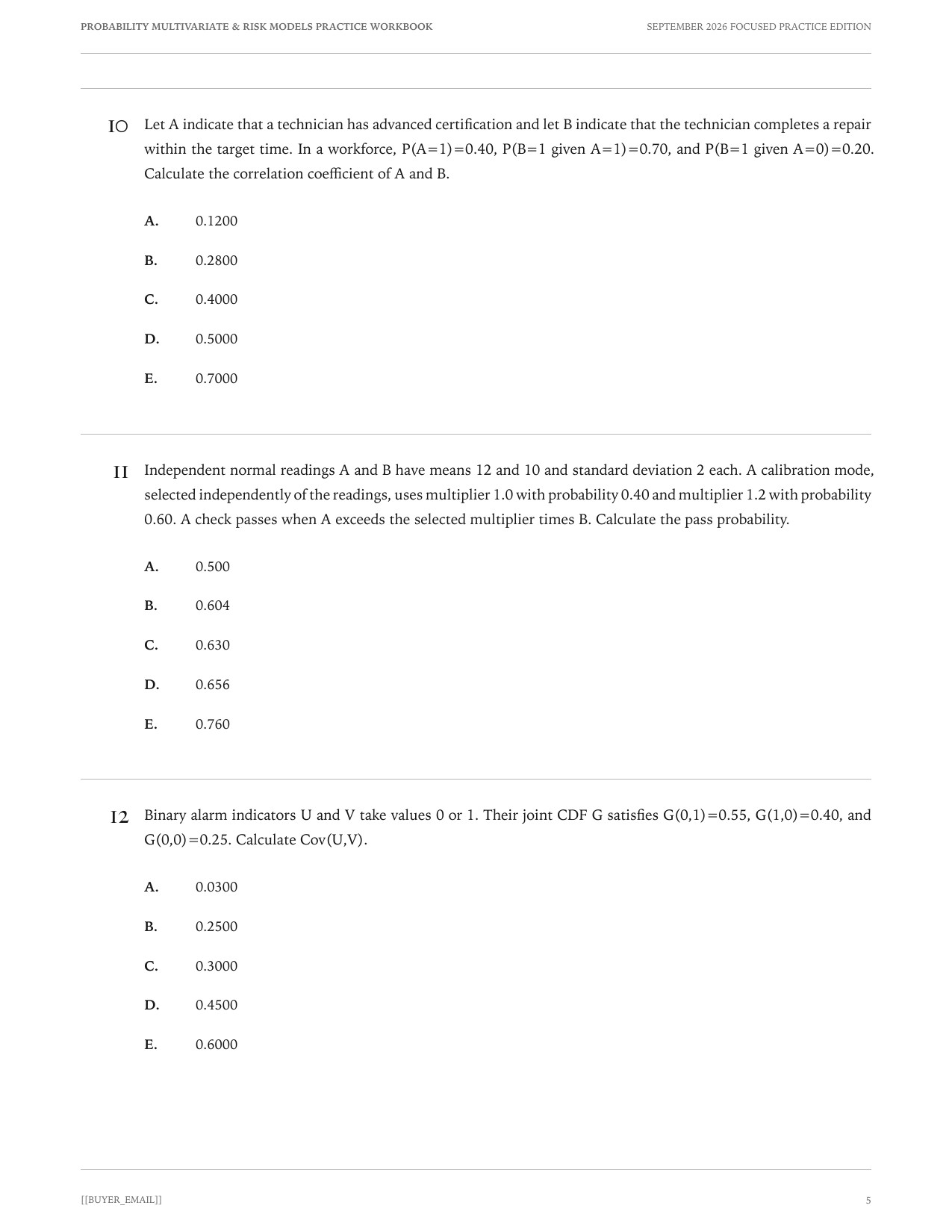
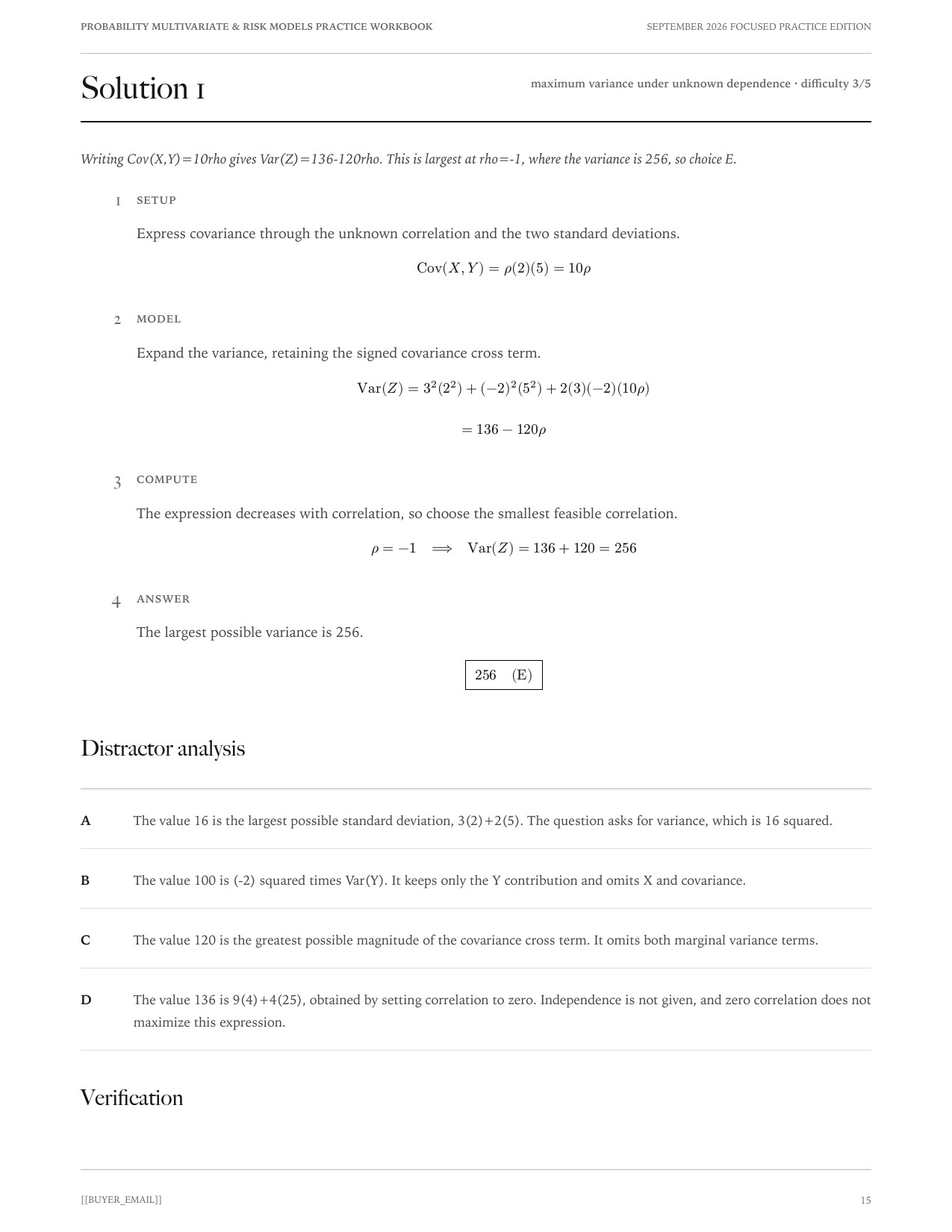
Check the method before checkout.
Complete HTML sample
One original Exam P practice question with full solution
The marginal variances of two calibration errors are Var(X)=4 and Var(Y)=25. Their correlation is not specified and may take any feasible value from -1 through 1. An index is defined as Z=3X-2Y+7. Calculate the largest possible value of Var(Z).
- 16
- 100
- 120
- 136
- 256
Writing Cov(X,Y)=10rho gives Var(Z)=136-120rho. This is largest at rho=-1, where the variance is 256, so choice E.
Setup
Express covariance through the unknown correlation and the two standard deviations.
Model
Expand the variance, retaining the signed covariance cross term.
Compute
The expression decreases with correlation, so choose the smallest feasible correlation.
Answer
The largest possible variance is 256.
Why the other choices are wrong
- A
- The value 16 is the largest possible standard deviation, 3(2)+2(5). The question asks for variance, which is 16 squared.
- B
- The value 100 is (-2) squared times Var(Y). It keeps only the Y contribution and omits X and covariance.
- C
- The value 120 is the greatest possible magnitude of the covariance cross term. It omits both marginal variance terms.
- D
- The value 136 is 9(4)+4(25), obtained by setting correlation to zero. Independence is not given, and zero correlation does not maximize this expression.
Independent answer check
| Primary value | 256 |
|---|---|
| Primary method | Expand the correlated linear-combination variance as a function of rho and optimize it over [-1,1]. |
| Independent value | 256 |
| Independent method | The standard-deviation bound for 3X-2Y is 3SD(X)+2SD(Y)=6+10=16. Perfect negative correlation between X and Y makes the two weighted random parts move together, attaining variance 16 squared=256. |
| Answer | E · agreement passed |
Contents
Inside the 76-page edition
Candidates preparing in English for the Probability (P) Exam
Table of contents
- 30 original multivariate problems
- Joint, marginal, and conditional models
- Covariance and linear combinations
- Order statistics and independent sums
- Central limit theorem and error diagnostics
What is included
30 verified original variants selected without duplication for this focused diagnostic. Official problem wording is not included.
Verification
Every included result is reproducible
Every selected problem already passed a reproducible calculation, an independent second method, and answer-letter agreement. The compiler rejects any failed check, cross-product duplicate, or official source wording.
Delivery
Personal PDF, reusable download
Stripe Checkout calculates applicable tax. Your copy is stamped with your purchase email, and the same address can request a fresh download link later.
Contact inshihub.com@gmail.com within 14 days for a delivery failure, unreadable file, duplicate charge, or material mismatch with this description. Change of mind and exam outcome are not refund grounds. Mandatory consumer rights remain unaffected.
Need the complete worked library?
Probability Proof Manual
Get the complete verified reference and original-variant bank when you need full coverage.
Before you buy
Questions about this edition
Are these official sample questions?
No. Every question is an independently written original variant. Official problem wording is not reproduced.
Are complete solutions included?
Yes. Every problem includes Setup, Model, Compute, and Answer steps plus a concrete explanation for each of the four incorrect choices.
How are the answers checked?
Each answer must agree under a reproducible primary calculation and a distinct independent method before the PDF can build.
Does this overlap the complete proof manual?
Yes. These 30 original variants are selected from the verified variant bank included in the Probability Proof Manual. This edition adds a curated focused diagnostic, answer sheet, answer key, and focused purchase price.
Independent publication
Rights and trademarks
ActuaryProof is not affiliated with, endorsed by, or sponsored by the Society of Actuaries. Exam names are used solely to identify the exams for which these study materials are relevant. All problems and solutions are original works.
Probability Multivariate & Risk Models Practice Workbook
Get the PDF
76 pages · 30 new practice problems · $19